If you ask most cloud providers what hardware you need for a new AI or simulation workload, the answer is almost always the most expensive GPU in their inventory.
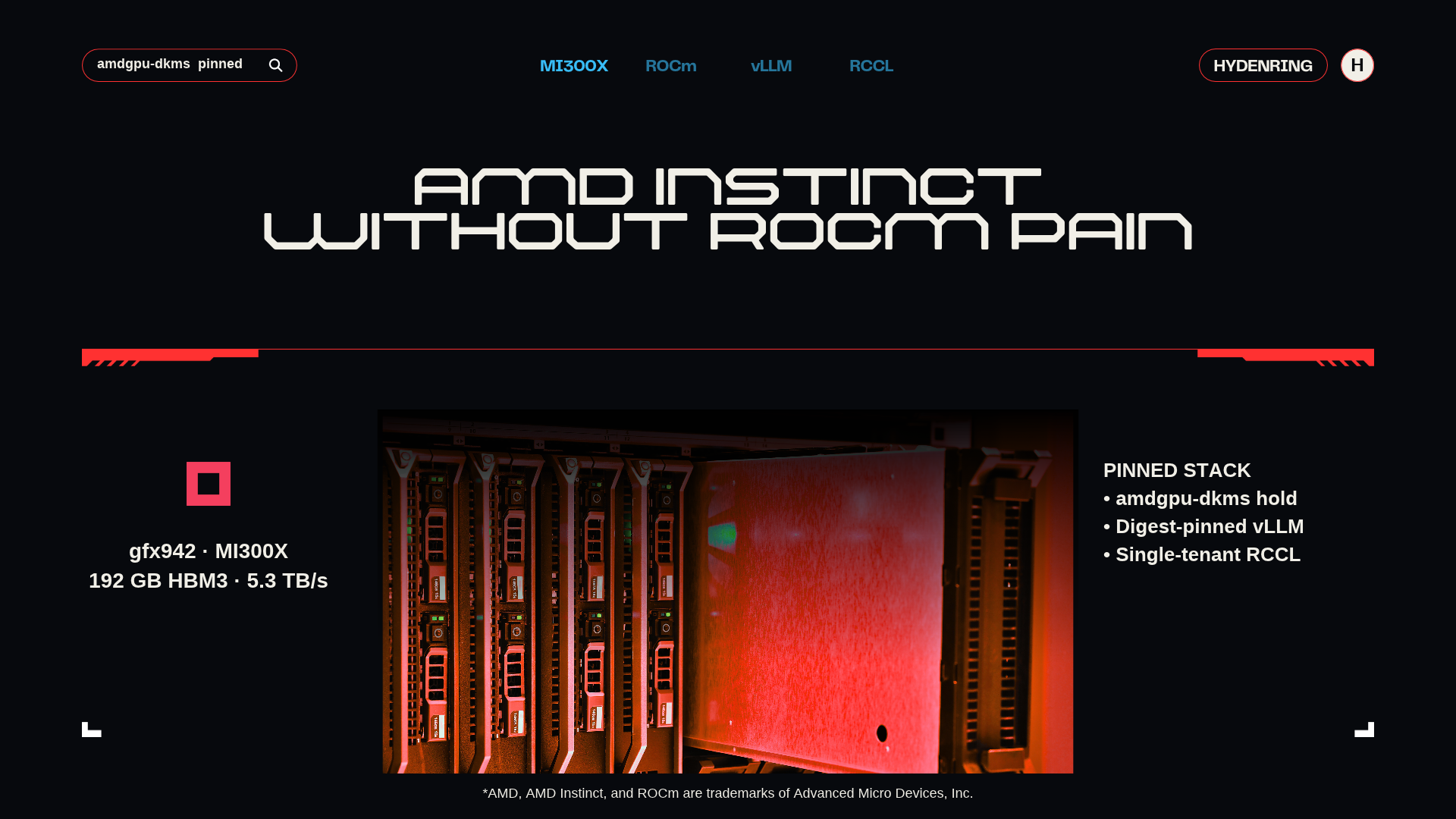
Ask for an OpenFOAM or MOOSE cluster? You get quoted an H100 node. Ask for 70B inference? You get quoted an 8-GPU H100 pod, even when a single-node AMD Instinct MI300X (192 GB HBM3, 5.3 TB/s memory bandwidth per GPU) vs NVIDIA H200 (141 GB HBM3e, 4.8 TB/s) comparison shows you can avoid half your tensor-parallel overhead. Ask for a steady-state API or preprocessing pipeline? Nobody mentions that a high-memory EPYC or Xeon CPU node starting at ₹1,499/mo (~$16/mo) can beat a GPU on cost per request.
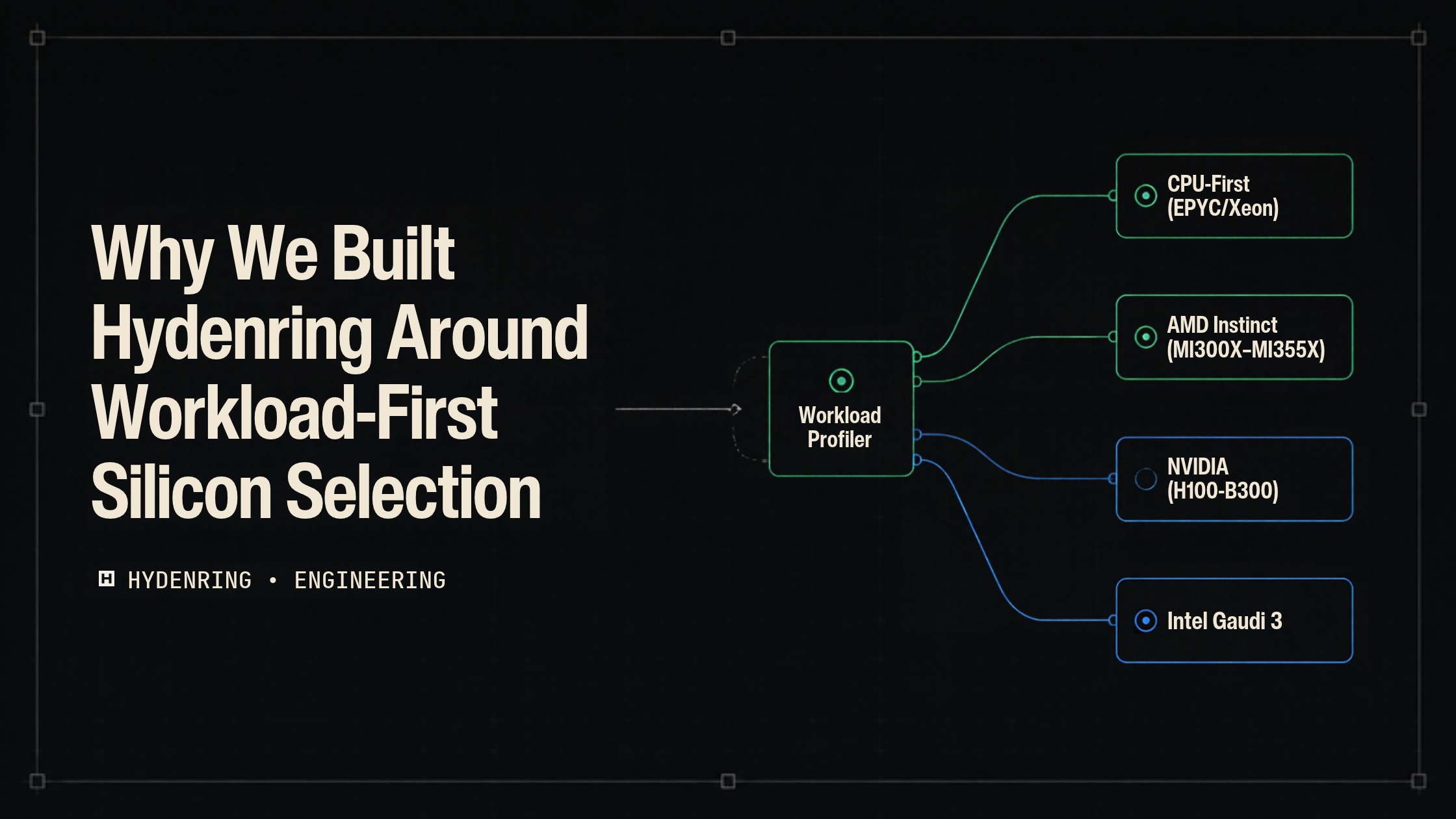
We built Hydenring around a simple operational rule: profile the bottleneck first, then pick the silicon. Whether you need high-RAM CPU nodes or dedicated bare metal GPU servers, if a CPU is sufficient, we do not upsell a GPU.
1. The Single-Vendor GPU Tax
Buying compute strictly by $/hr sticker price—or default cloud GPU pricing tiers—hides two real-world taxes:
- Idle Silicon Tax: Sparse finite-element (
MOOSE, implicit FEA) and routine steady-state CFD (OpenFOAMsimpleFoamoricoFoamunder 10M cells, or models relying on Arbitrary Mesh Interfaces / cyclic boundaries and custom C++/Fortran UDFs) are dominated bylduMatrixsparse-matrix memory-bandwidth saturation, PCIe host-to-device transfer bottlenecks, or MPI latency, not FP16 FLOPs. Putting a sparse, memory-bound solver on anH100leaves most Streaming Multiprocessors (SMs) idle while you pay GPU rates instead of ₹1,499/mo (~$16/mo) managed CPU pricing. - Porting & Runtime Tax: Conversely, forcing an established
TensorRT-LLMor proprietary CUDA-extension pipeline ontoROCmpurely for GPU sticker price burns weeks of engineering time. On the other hand, teams serving 70B+ open-weight models (Llama,Qwen,DeepSeek,Mistral) viavLLMorSGLangoften overpay for multi-GPU NVIDIA pods when AMD Instinct MI300X (192 GB HBM3,5.3 TB/s) orMI325Xfits the model on fewer GPUs—once theROCmcontainer digest andRCCLtopology are properly pinned.
2. How We Profile Bottlenecks Before Quoting Hardware
Every Workload Review checks four constraints before recommending CPU nodes or bare metal GPU instances:
| Bottleneck / Requirement | When CPU Wins (EPYC / Xeon) |
When AMD Instinct Wins (MI300X–MI355X) |
When NVIDIA (H100–B300) or Intel (Gaudi 3) Wins |
|---|---|---|---|
| Primary Limit | Memory bandwidth per core, 512 GB–2 TB+ system RAM, MPI latency | VRAM capacity & bandwidth (192 GB HBM3, 5.3 TB/s on MI300X) |
Proprietary CUDA kernels, TensorRT-LLM plugins, H200 (141 GB HBM3e, 4.8 TB/s), FP8/BF16 training |
| Typical Workloads | Steady-state OpenFOAM, implicit FEA, LAMMPS CPU runs, APIs, data loaders |
70B+ open-weight vLLM / SGLang inference, long-context serving |
Multi-node NCCL pretraining, Megatron-LM, CUDA-only solvers |
| Runtime & Packaging | Apptainer / Nix reproducible builds, fast NVMe scratch |
Pinned ROCm / HIP digests + rocm-smi --showtopo |
CUDA / cuDNN / oneAPI (Gaudi 3) |
| Pricing Anchor | Managed CPU from ₹1,499/mo (~$16/mo) | Custom/dedicated TCO via hydenring.com/compare |
Custom/dedicated TCO via hydenring.com/compare |
Before spinning up any node, we run two sanity checks:
# 1. On AMD Instinct nodes: verify XGMI / PCIe topology before tensor-parallel runs
rocm-smi --showtopo

# 2. Always pin an immutable @sha256:<digest> (never pip-upgrade torch in-place on ROCm)
apptainer exec --rocm docker://rocm/vllm@sha256:<pinned-digest> python3 -m vllm.entrypoints.openai.api_server --help
3. When Bare Metal GPUs Actually Win (And When They Don't)
To be completely direct about boundaries:
- Choose high-core
EPYC/XeonCPU nodes when your model exceeds affordable VRAM, your solver depends on unported C++/Fortran UDFs, or your workload is a preprocessing / API / medium-mesh CFD job. - Choose AMD Instinct (
MI300X,MI325X,MI350X,MI355X) when VRAM per chip (192 GB HBM3+,5.3 TB/s) lets you cut tensor-parallel splits and you want AMD Instinct without the ROCm pain—we handle the container digest pinning,RCCLtuning, andvLLMsanity checks. - Choose NVIDIA (
H100,H200,B200,B300) or IntelGaudi 3when your stack relies onTensorRT-LLM,CUDA-specific extensions, oroneAPIpipelines where porting cost outweighs hardware savings. - Hybrid AI + Physics (
hydenring.com/custom-request): For teams couplingOpenFOAM,LAMMPS, orMOOSEdata generation on CPU-MPI withPyTorch/JAXsurrogate training on bare metal GPU servers, we build custom topologies starting from ₹50,000+ (~$542+) with reproducibleApptainer/Nixmanifests.
4. Sovereign Residency & Transparent Support Hours
Hardware choice only matters if operations match your compliance and budget reality:
- Residency (
hydenring.com/regions): Single-tenant bare-metal placement across India (sovereign data residency), Europe (GDPR-aligned), and North America (high-density silicon)—keeping weights, NVMe scratch, and 14-day offboarding snapshots in-region. - Honest SLA (
hydenring.com/sla): Instead of putting fake "24/7 enterprise support" in a footer and baking support theater into every invoice, our staffed engineering hours are Monday–Friday, 09:30–18:30 IST (UTC+5:30) excluding Indian public holidays, with automated monitoring continuously active and optional paid emergency escalation (₹9,999activation +₹5,000/hr).
Try the Live TCO Math
You can compare CPU, NVIDIA, AMD Instinct, and Intel Gaudi 3 economics side-by-side in INR and USD with zero email gates at hydenring.com/compare, or submit your solver/model profile at hydenring.com/workload-review.
Quick FAQ
Does Hydenring lock you into one GPU vendor?
No. We operate AMD Instinct, NVIDIA, Intel Gaudi 3, and high-memory EPYC/Xeon CPU nodes and route your workload to whichever gives the best throughput per rupee or dollar.
Can we run India-only or EU-only bare metal GPU or CPU workloads?
Yes. Specify your residency constraint in Workload Review so bare-metal compute, NVMe scratch, and offboarding snapshots stay strictly inside India or Europe.
About the author
- Dedicated AI, Scientific & Production Compute. Bare-metal GPU clusters, HPC & sovereign ops. Support: Mon-Fri 09:30-18:30 IST (UTC+5:30). Links: hydenring.com | Bluesky: @hydenring.bsky.social | HF: huggingface.co/hydenring-compute | Dev.to: dev.to/hydenring | Reddit: u/hydenring_compute
Comments
Join the discussionNo comments yet. Be the first to comment.